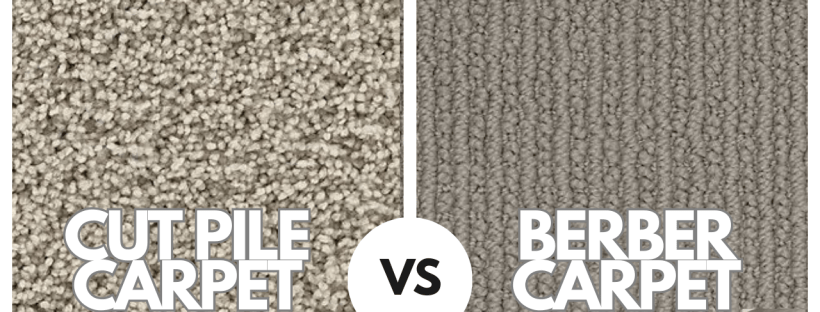
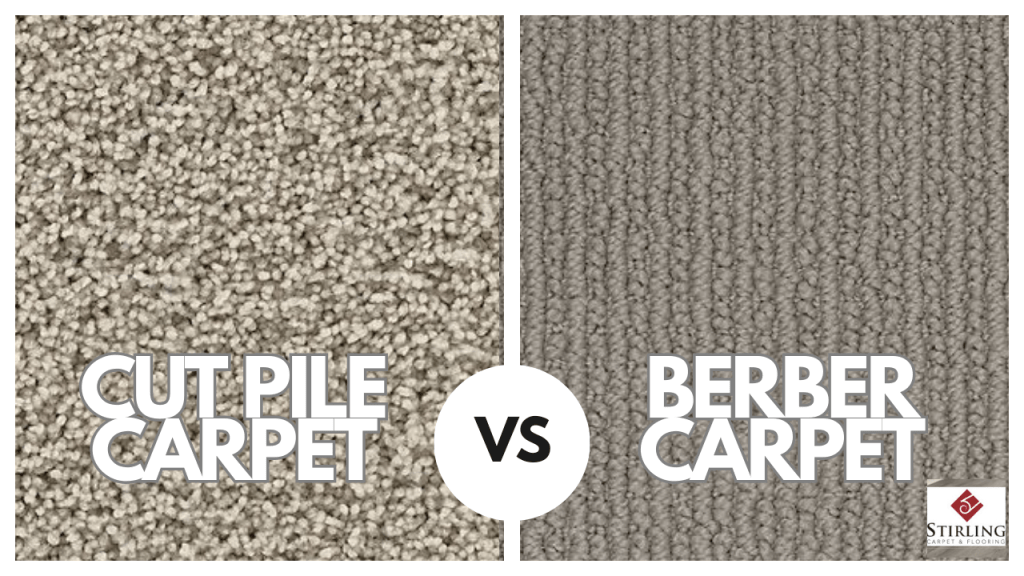
Cut pile and Berber are the two most common types of carpet that you can purchase for your home. Both have great advantages, depending on what you are looking for. You can get a combination of the two as well, creating more patterns, but for the purpose of this article, we will be focusing on the two separately.
What is Cut Pile carpet?
Cut pile is the soft, plush version of carpet that screams luxury. The soft fibres are created when twisted, looped carpet strands are punched through a primary backing, and then the loops are cut to expose the fibers. This creates a plush, frayed carpet that feels comfortable under your feet. Cut pile carpet is typically made of Nylon, Wool, or Polyester. Both shag, and frieze carpets are cut pile carpets, but there are other options that are more suited to the current design market.

Pros
- Cut pile is the most comfortable under your feet because of the soft open fibres. This carpet also grows in plushness with pile height and density.
- Cut pile carpet is not woven in rows, but rather punched in individual cut loops, so it does not “run” like a Berber would. If you were to find that a fiber is loose, it would simply pull out on its own, and the hole would be covered up by the neighbouring fibres.
- Repairing a patch of Cut pile is easier than repairing a Berber because there are no rows to match up.
- There are tons of colour options. Many Cut pile carpets are also flecked with multiple different colours throughout. When the carpet is flecked, it tends to hide hair and dirt more effectively.
- Because Cut pile is so neutral, with its pattern and colour options, this carpet is suitable for any home design or personal taste. This type of carpet is not likely to go out of style any time soon.
Cons
- Because it is so plush, there is a higher likelihood of the pile crushing in high-traffic areas. This could result in obvious trails, paths, or footprints being visible. The fibers are coiled and the tighter the coil, the less likely it will be to crush, but this is a reality with Cut pile carpet.
- The open weave holds onto dirt. Vacuuming regularly can help to solve this problem, but over time, dirt can become permanently trapped under the weave.
- The seams on this type of carpet can be more noticeable if they are not done really well. Because there is no pattern to hide the split, if the weave is off at all, it becomes visible.
- Cut pile carpet does not usually have as long of a life as Berber carpet. It is softer, and therefore more delicate. It can crush and wear out in a shorter amount of time than Berber. The average life of a Cut pile carpet is about 12-15 years in high-traffic areas.

What is Berber carpet?
Berber carpet is the classic carpet that is practical, stylish, and comfortable in more ways than one. Berber is a woven carpet that is made up of lots of small loops that are woven in rows. The loops are tightly twisted to create sturdy and resilient flooring. The loops can also be woven at different heights to create new patterns and unique textures. Berber is primarily made of Nylon, Wool, or Olefin. Many manufacturers are coming up with ideas to use recycled materials to make carpet fibers for both cut pile and Berber carpet, though Berber lends itself to post-consumer materials well because it is traditionally flecked with many different colours.
Pros
- Berber carpet is very durable. Because of its tight, looped construction, it holds up against heavy foot traffic really well. You won’t see paths and footprints in a Berber carpet.
- It is typically more affordable than Cut pile carpet.
- Seams are easier to hide in a Berber carpet because there are already rows to follow. Typically, Berber is also multi-coloured, so the seam blends in a lot better.
- Dirt, dust, and hair tend to stay on top of the loops instead of being absorbed like a Cut pile carpet. This makes Berber great for commercial spaces like offices and stores where people rarely remove their shoes.
- A lot of these factors give Berber its reputation for being so long-lasting. Some Berber carpets have been known to last upwards of 25 years.
Cons
- Runs can be created by a loop being pulled up. Because the fibers are woven together if a singular loop is pulled, the whole row could be pulled along with it. Things like pet claws, high heels, and vacuum beater bars can pull at rows. It is important, if you notice a loop is loose, that you fix it right away. You can do this by gluing the loose loop to the backing where it used to be attached or by cutting the loop off at the base. This does leave a gap in your carpet, but it will prevent the row from pulling further. Ultimately, the best option is to hire a professional to fix the damage as soon as possible.
- Because Berber is tightly woven and durable, it is not as plush underfoot as a Cut Pile carpet. It is still much more comfortable than any hard surface flooring choice, but if you are looking for luxury, Berber is not the way to go.
- It can be more difficult to repair a Berber carpet because you must match up the rows. This is not to say that it is impossible to repair, but you would need a larger spare piece to line everything up properly.
- Berber has been popular for a long time because of its durability and affordability, not its style. Berber carpet is not ugly, but homeowners tend to lean towards the visual of a neutral Cut Pile carpet, over a looped Berber that could be considered “busy”. And because it’s not as popular nowadays, there are not as many colour options.
What does this mean for you?
It’s up to you to decide where your priorities lie. Does your flooring need to stand up to high traffic where people may not always take off their shoes? Or maybe your flooring will have little ones learning to walk and needing a soft place to land. Are you passionate about having high recycled content in your flooring? Perhaps you are looking for a very specific colour. Each style has many good things to offer, all you need to do is let us know what you need “Under your feet!”
 What's Under Your Feet?